
Cattle Scales: The Complete Buyer's Guide to Livestock Scales for Cattle
Updated October 15, 2026
The short answer: the best cattle scale is the one that fits your heaviest animal, your facility and how you handle cattle. For most ranches that means an alleyway or cage scale, or weigh bars under an existing chute or pen, paired with a digital indicator that holds a steady reading on a moving animal. This guide covers every type of cattle scale, how to size one, the features that matter, current Liberty prices and how often to weigh your herd.
Why accurate cattle weights matter
- Correct dosing. Most dewormers, antibiotics and pour-ons are dosed by body weight. A guessed weight means animals are over- or under-treated.
- Feed costs. Feed is usually the biggest cost in a beef operation. Real weights let you match rations to the animals instead of feeding to a guess.
- Selling at the right time. Cattle sell by the pound. Knowing where each group stands lets you time the sale instead of finding out at the buyer's scale.
- Breeding and culling. Weaning weights and average daily gain show which cows and genetics produce efficient growth, and which animals are falling behind.
Types of cattle scales
Alleyway cattle scales
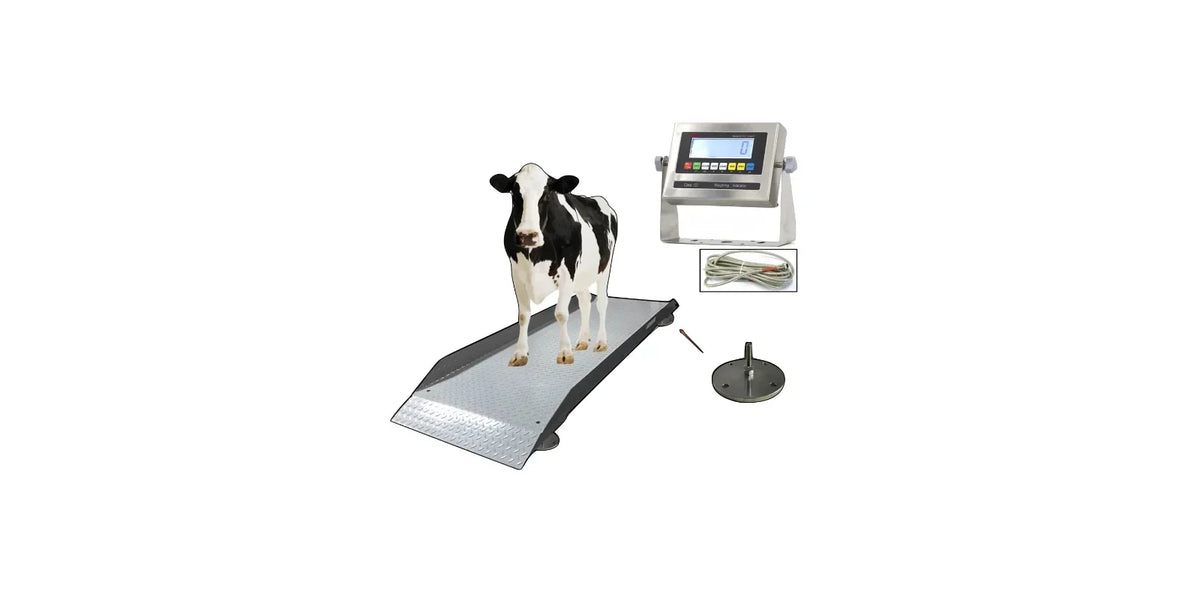
An alleyway scale is a long, narrow platform with ramps that sits in line with your working alley. Cattle walk on, stop for the reading and walk off. It is the most practical choice for ranches that weigh animals one after another. The Liberty LS-929 alleyway scale comes in 7' x 26", 7' x 36" and 8' x 48" sizes, and the LS-929-M aluminum alleyway is rated 2,500 lb x 1 lb.
Cage cattle scales
A cage adds side panels and gates around the platform, so the animal is contained without being restrained. Cages suit operations with no permanent chute, nervous cattle or a single handler. Liberty's LS-930 cage systems run from the 5' x 30" calf cage (2,000 lb x 0.5 lb) to the 6' x 30" USA-made cage (5,000 lb x 1 lb or 10,000 lb x 2 lb) and larger 5' x 7' and 10' x 7' platforms.
Weigh beams and load bars
Weigh beams are two steel bars that go under a chute, pen or custom platform and connect to an indicator. They are the most flexible option if you already have handling equipment. The LS-WB weigh beam system comes in 24" to 60" lengths with capacities from 5,000 lb x 1 lb to 20,000 lb x 2 lb, and the LS-919-HD heavy-duty beams are available up to 20,000 lb.

Platform and floor scales
A large platform scale can weigh cattle as well as feed, grain or equipment, which suits mixed farms that weigh animals only now and then. The LS-700 5' x 7' floor scale comes in capacities from 1,000 lb x 0.2 lb to 10,000 lb. Add ramps and a non-slip surface for livestock use.
Portable cattle scales
Most alleyway and cage scales are portable: they set up without concrete work and move between pens or properties. Read more in our guide to portable cattle scales.
Calf and small-animal scales
For calves, sheep, goats and hogs, a low platform or small cage is easier on the animals. The LS-920-2K (50" x 20", up to 2,000 lb) and the LS-922 vet scale (43" x 20" stainless platform, 2" profile) cover this range. See our calf scales buyer's guide for details.
Cattle scales for chutes, and weighing without one
If you have a squeeze chute, weigh bars mounted under it let you weigh each animal while it is held for treatment. Check the chute manufacturer's guidance for mounting, and measure the chute footprint before choosing a bar length.

No chute? Three setups give accurate weights without one:
- Alleyway platform in the working alley. Animals walk across in single file. It suits small and mid-size herds and operations without permanent concrete facilities.
- Portable cage. Gates hold the animal on the platform for the reading, then open to let it walk out. It gives more control with larger or more excitable cattle.
- Weigh beams under a pen floor. Set the bars on firm, level ground and build the platform over them.
Digital cattle scales: what the indicator does
The indicator is the digital display and brain of the scale, and it decides how easy weighing is. Look for:
- A steady reading on a moving animal. Cattle shift their weight. The LS-929 uses motion-sensing technology to settle the reading even with restless animals.
- Battery operation. The LS-7510-SS indicator on the LS-929 has a rechargeable battery rated for about 100 hours, so you can weigh in the pasture.
- Washdown resistance. The LS-7510-SS is stainless steel and NEMA 4 rated for washdown.
- Accumulation mode. Totals the weight of several animals, useful when you sell or move groups.
- Data output. If you track weights in software or tie them to EID tags, check the indicator's connectivity before you buy.
How to size a cattle scale
Capacity
Choose a scale rated comfortably above your heaviest animal. Headroom protects the load cells when an animal jumps or several crowd onto the deck, and it keeps the scale accurate over time. Never load a scale beyond its rated capacity.
Platform size
The animal has to fit with all four feet on the deck. Measure your largest animals and your alley, and leave room so cattle are not pressed against rails, which can push weight off the platform.
Readability
Readability (for example 1 lb or 2 lb) is the smallest step the scale displays. Higher-capacity scales usually read in larger steps. For calves and small animals, a finer reading such as 0.5 lb is more useful.
Liberty cattle scales compared
| Model | Type | Size | Capacity | Price* |
|---|---|---|---|---|
| LS-929 | Alleyway | 7' x 26", 7' x 36", 8' x 48" | See product page | From $1,378.99 |
| LS-929-M | Aluminum alleyway | 7' x 26" | 2,500 lb x 1 lb | $1,999 |
| LS-930 6' x 30" USA | Cage | 6' x 30" | 5,000 lb x 1 lb or 10,000 lb x 2 lb | From $3,735.99 |
| LS-930 5' x 7' | Cage | 60" x 84" | See product page | $2,873.99 |
| LS-WB | Weigh beams | 24" to 60" bars | 5,000 lb to 20,000 lb | From $573.99 |
| LS-919-HD | Heavy-duty weigh beams | Several lengths | Up to 20,000 lb | From $665.99 |
| LS-700 5' x 7' | Platform | 60" x 84" | 1,000 lb to 10,000 lb | From $1,999 |
*Prices from libertyscales.com on October 15, 2026. Prices and stock can change; the product page always shows the current price.
Shop all livestock scales for cattle, or ask our team which size fits your herd and facility.
How often to weigh cattle
Most cow-calf and stocker operations get good results from weighing at key moments, plus regular check weights while animals are growing:

| Stage | When to weigh | Why |
|---|---|---|
| Birth | As close to birth as practical | Baseline for growth and herd records |
| Weaning | At weaning | Key benchmark for cow and calf performance |
| Growing cattle | About every 30 days | Track average daily gain against your targets |
| Before sale | Every 2 weeks as market weight gets close | Time the sale and avoid over- or under-weight groups |
| Cows | Before breeding and before calving | Manage body condition and nutrition |
| Any treatment | Every time you dose by weight | Accurate dosing |
Average daily gain is the number to watch: weight gained divided by days between weighings. Track the trend for each animal and pull out the ones falling well behind the group.
Tips for accurate readings
- Set the scale on firm, level ground and level it before the first animal.
- Zero the scale at the start and whenever mud or manure builds up.
- Move cattle quietly and let each animal settle before you record the weight.
- Weigh at the same time of day, ideally before feeding and watering, so readings compare fairly.
- Record each weight with tag number and date.
- Clean the deck after each session and keep the indicator and cable dry.
Weighing day safety
A good weighing day is a calm one. Quiet handling gives steadier readings and keeps people and cattle from getting hurt:
- Check the setup first. Make sure panels, gates and pins are secure and the scale deck and approach have non-slip footing with no gaps a hoof can catch in.
- Light the entrance evenly. Cattle often balk at shadows, glare or dark openings, so avoid a bright-to-dark step at the scale entrance.
- Work the flight zone. Move cattle from the side at a walk, and avoid standing directly behind an animal in its blind spot.
- Never get pinned. Don't stand between an animal and a panel or swinging gate, and always keep an escape route.
- Use two people. One moves cattle while the other runs the indicator and records weights.
- One animal at a time on single-animal scales, and never load a scale beyond its rated capacity.
Selling cattle by weight
If the scale weight sets the sale price, your state may require a legal-for-trade scale that has been inspected and sealed before commercial use. Rules vary, so check with your state weights and measures office, and use a qualified scale technician for installation and certification. Our guide to NTEP and legal-for-trade scales covers the basics. Weights used only for your own records, such as dosing and growth, usually do not need a certified scale.
Liberty livestock scales are factory calibrated before they ship. After moving a scale, a heavy impact or any doubt about accuracy, have a qualified technician check it, and follow the maintenance steps in the manual.
Cattle scale FAQs
What type of cattle scale is best for a small cow-calf operation?
A portable alleyway scale or cage system is usually the best fit. Both set up without concrete work, move between pens and handle calves through mature cows if sized correctly.
What capacity cattle scale do I need?
Pick a scale rated comfortably above your heaviest animal. For calves and small livestock, 2,000 lb is common. For mature cattle, look at 5,000 lb or larger cages, alleyway scales or weigh beams.
How much does a cattle scale cost?
As of October 15, 2026, Liberty weigh beam systems start at $573.99, LS-929 alleyway scales start at $1,378.99, and cage systems for adult cattle start at $2,873.99. Check each product page for the current price.
What is the difference between an alleyway scale and a cage scale?
An alleyway scale is an open platform that cattle walk across in line with your alley. A cage scale adds gates and panels to hold the animal on the platform, which gives more control with nervous or larger cattle.
Can I weigh cattle without a squeeze chute?
Yes. An alleyway platform, a portable cage or weigh beams under a pen floor all give accurate weights without restraining the animal.
What causes inaccurate cattle scale readings?
The usual causes are uneven ground, mud or manure on the deck that was not zeroed out, an animal leaning on a panel or gate, more than one animal on the scale, and damaged load cells or cables.
Find the right cattle scale
Browse the livestock and agriculture scales collection, read our guides to scales for goats, sheep and pigs and calf scales, or call Liberty Scales at (661) 888-1919 for help choosing. You can also send us a message.