
Test Weights for Scales: Grip Handle, Cast Iron and Certified Options
Updated November 8, 2026
The short answer: test weights are certified masses you put on a scale to check that it reads correctly. For bench, floor and platform scales, most buyers use cast iron or stainless steel grip handle weights in pound or kilogram sizes; for lab balances, you need small precision calibration weights instead. Pick weights whose error is no more than about one-third of your scale's tolerance, buy enough to reach a meaningful share of capacity, and add a calibration certificate if an auditor or customer needs proof. Below: the weight types, how much test weight you need, how to run a basic scale check, and Liberty's grip handle test weights with current prices.
What are test weights?
A test weight is a mass whose value is known within a stated tolerance. Put it on a scale and the reading tells you whether the scale is right. The same idea covers a 1 mg lab weight and a 50 lb cast iron block, but the weights, tolerances and paperwork are very different.
- Calibration weights for balances are small, precise weights in ASTM or OIML classes. Our guide to calibration weight classes covers those.
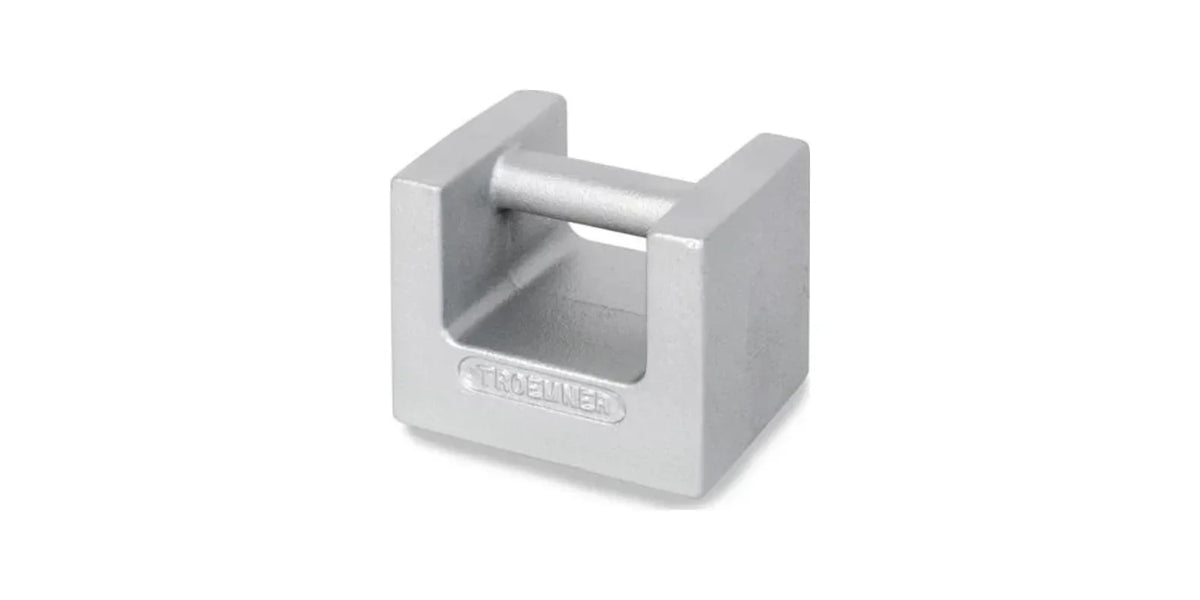
- Test weights for scales (this guide) are larger weights, usually 5 lb to 50 lb or 1 kg to 20 kg, used on bench, floor, pallet and platform scales. They usually have a grip handle so they can be lifted safely.
Types of test weights
Cast iron grip handle weights
The workhorse for floor and bench scales. Cast iron is affordable and tough, which is why scale service companies carry stacks of them. The trade-off is wear: NIST Handbook 105-1 notes that cast iron weights used routinely may need much more frequent calibration than stainless steel because they wear and corrode.
Stainless steel grip handle weights
Stainless steel holds its value longer and is easier to keep clean, which matters in food, pharmaceutical and washdown areas. Ohaus offers grip handle weights in ASTM Class 4, ASTM Class 1 and its UltraClass line, with or without a calibration certificate.
Cylindrical and small weights
For balances and small bench scales, cylindrical stainless weights and weight sets give finer steps. See the calibration weights collection.
How much test weight do you need?
There is no single rule for every scale, but these points keep you on safe ground:
- Accuracy first. NIST Handbook 105-1 uses the principle that a test weight's maximum permissible error should be no more than one-third of the tolerance of the device being tested. A weight that is less accurate than that can't tell you whether the scale is right.
- Cover the range you use. Check near your typical load, not just at a few pounds. A floor scale that weighs 1,000 lb pallets is best checked with a meaningful load, built from several weights.
- Buy round numbers. A few 50 lb weights plus 25, 10 and 5 lb weights let you build many test loads.
- Never exceed the scale's rated capacity, including the weight of any container or pallet you test with.
For legal-for-trade scales, official testing is done by your state weights and measures office or a registered service company with certified field standards. Your own test weights are for routine checks between those visits.
How to check a scale with test weights
- Warm up and zero. Turn the scale on, let it warm up as the manual says, clear the platform and press zero.
- Place a known weight in the center. Record the reading and compare it with the weight's value.
- Corner (shift) test. Put the same weight on each corner or section of the platform. Readings should match the center reading within your tolerance.
- Increase the load. Add weights in steps toward your normal working load, recording each reading, to see whether the error grows.
- Repeat a reading. Remove and replace the same weight several times. The readings should repeat.
- Return to zero. Remove everything; the display should come back to zero.
- Log it. Record the date, the weights used and every reading.
If a reading is out, don't adjust a legal-for-trade scale yourself. Have a qualified scale technician calibrate it, and check with your state weights and measures office about re-sealing. Scale Blog has a deeper walkthrough of industrial scale calibration.
Certificates and recalibration
A certificate records the weight's measured value and its uncertainty, and is what an auditor will ask for. Ohaus grip handle weights are listed with no certificate, with a certificate traceable to NIST, or with an ISO/IEC 17025 accredited (NVLAP) certificate.
Weights drift, so they need recalibrating. NIST Handbook 105-1 says intervals for field standards often start at one year and are adjusted from the weight's history, and should not exceed five years. Heavily used cast iron weights may need checking more often. Store weights clean and dry, and lift them by the handle.
Liberty grip handle test weights and prices
| Product | Material / class | Certificate | Price* |
|---|---|---|---|
| Ohaus cast iron grip handle test weights, pounds | Cast iron, Class F | None, traceable or NVLAP options | 5 lb $109.99; 10 lb $138.99; 20 lb $182.99; 25 lb $224.99; 50 lb $250.99. Larger sizes: call for price |
| Ohaus cast iron grip handle test weights, metric | Cast iron, Class F | See product page | Up to $483.99; some sizes call for price |
| Grip handle Class 4 weights | ASTM Class 4 | None (traceable and NVLAP versions available) | $734.99 to $2,374.99 by size |
| Grip handle Class 1 weights | ASTM Class 1 | Traceable to NIST | $1,154.99 to $3,707.99 by size |
| Grip handle UltraClass weights | Ohaus UltraClass | NVLAP | $1,453.99 to $4,535.99 by size |
*Prices from libertyscales.com product pages on November 2, 2026. Prices can change; the product page always shows the current price.

Most floor scale owners start with a few 50 lb cast iron weights. If you work to an ISO or customer audit, choose a certified stainless option instead.
Test weight FAQs
What is the difference between test weights and calibration weights?
Both are known masses. Calibration weights usually means small precision weights for lab balances, in ASTM or OIML classes. Test weights usually means larger grip handle weights, often cast iron, used to check bench, floor and platform scales.
What is a Class F test weight?
Class F is the NIST class used for field standard weights that check commercial scales. NIST Handbook 105-1 (2019) says new Class F standards should not be bought for legal metrology after January 1, 2020; existing ones may stay in use if they still meet requirements. For routine in-house checks, Class F cast iron weights remain common.
How accurate do my test weights need to be?
A common rule from NIST Handbook 105-1 is that the test weight's maximum permissible error should be no more than one-third of the tolerance of the scale being tested.
How often should test weights be recalibrated?
Many programs start at one year and adjust based on the weight's history, and NIST Handbook 105-1 says intervals should not exceed five years. Cast iron weights in heavy use may need more frequent checks.
Can I calibrate my own scale with test weights?
You can check a scale with test weights as a routine habit. Calibration and adjustment, especially of legal-for-trade scales, should be done by a qualified scale technician, and your state weights and measures office sets the rules for sealing.
Get the right test weights
Browse the calibration and test weights collection, read our scale accuracy guide, or see what NTEP certification means. For help choosing sizes and certificates, call Liberty Scales at (661) 888-1919 or send us a message.