
Livestock Load Bars and Weigh Bar Kits: How to Choose and Set Them Up
Updated November 11, 2026
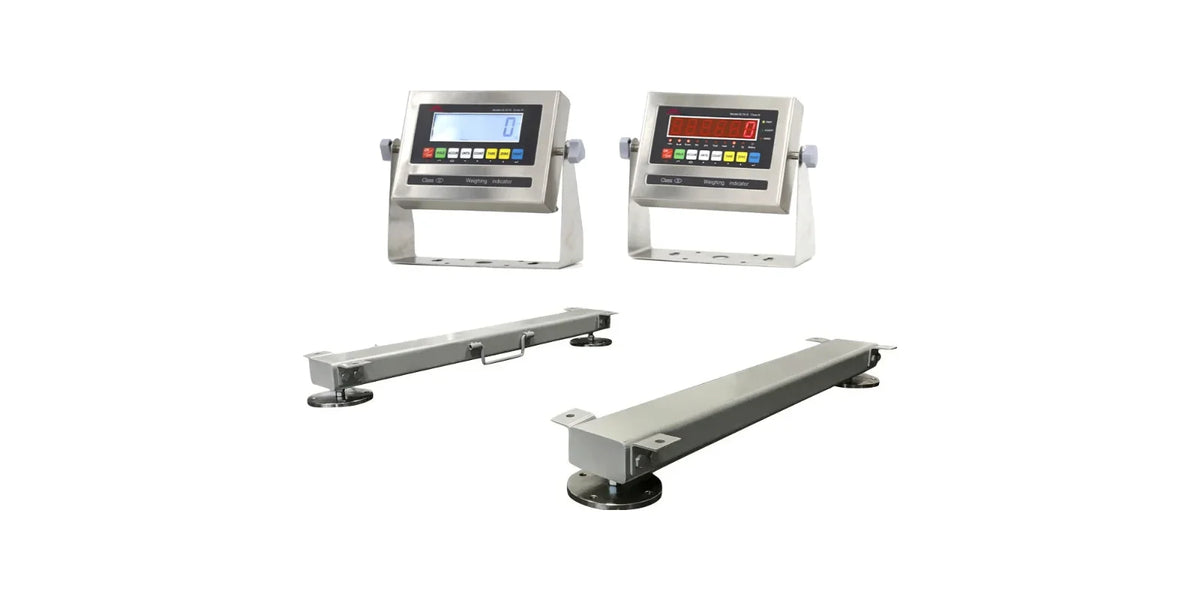
The short answer: livestock load bars (also called weigh bars or weigh beams) are a pair of steel bars with load cells inside that go under a platform, chute or crate and connect to an indicator, turning almost any solid base into a livestock scale. Choose the bar length to suit your platform, a capacity above your heaviest animal plus the platform's own weight, and an indicator you can read in the field. Liberty's kits start at $573.99 for a 24" 5,000 lb set and go up to 20,000 lb capacity. Below: how load bars work, how to size them, setup tips, and the kits we sell.
How livestock load bars work
Each bar has load cells (usually one at each end) that measure the force on them. Two bars set under opposite sides of a platform carry the whole load, and a cable from each bar runs to an indicator that adds the signals and shows the weight. Because the bars are separate from the platform, you can put them under almost anything that is rigid and stable: a squeeze chute, a wooden or steel deck, a sheep crate or a calf cage.
That flexibility is the main reason ranchers buy load bars instead of a complete scale. You can use a platform you already own, move the bars between sites, and replace the platform later without replacing the weighing parts.
Load bars vs a complete livestock scale
| Load bars (weigh beams) | Complete livestock scale | |
|---|---|---|
| What you get | Two bars plus an indicator | Platform, cage or alley with weighing built in |
| Platform | You supply or build it | Included |
| Best for | Chutes, crates and existing decks; moving between sites | A ready-to-use weighing station |
| Liberty examples | LS-WB, LS-919-HD | LS-929 alleyway, LS-930 cage |
If you'd rather buy a finished alleyway or cage, see our cattle scales buyer's guide.
How to choose bar length and capacity
- Length: match the bars to the width of the platform or chute so they support it close to the edges. Liberty's kits come in 24", 36", 40", 48" and 60" lengths.
- Capacity: add the weight of your heaviest animal (or group), the platform or chute itself, and a margin for animals that jump or lean. A squeeze chute alone can weigh well over 1,000 lb. Never load the bars beyond their rated capacity.
- Readability: the 5,000 lb kits read in 1 lb steps; the 10,000 and 20,000 lb kits read in 2 lb steps. For calves and small stock, the smaller step is easier to track.
- Indicator: the LS-919-HD is offered with an LCD or LED display. An LED display is easier to read in low light; LCD is often easier to read in bright sun.
Not sure how heavy your animals are? Our guide to how much a cow weighs has typical weights for cows, bulls and calves.
Setup tips for accurate weights
- Start with a firm, level base. Concrete pads are best. On dirt, use solid footings so the bars can't sink or rock.
- Set the bars parallel and square to each other, under the strongest parts of the platform or chute frame.
- Keep the load only on the bars. Nothing else (gates, side panels, fence posts, mud) should touch the platform, or part of the weight goes around the scale.
- Protect the cables from hooves, gates and chewing.
- Zero before every session and again when manure builds up.
- Check with a known weight now and then, such as a few test weights or a person of known weight.
Scale Blog has a detailed guide to setting up a livestock scale and chute system, including animal flow. If the weights will be used to buy or sell animals, check with your state weights and measures office about legal-for-trade requirements, and have a qualified scale technician handle installation and certification.
What regular weighing pays back
Weights turn guesses into decisions: dosing by actual weight, tracking gain, picking replacement heifers from cows that wean heavy calves, and knowing what you're selling. NDSU Extension's Dickinson Research Extension Center, for example, tracked calves averaging 88 lb at birth and 558 lb at weaning across five years; records like these are only possible with a scale.
Liberty load bar kits and prices
| Kit | Lengths and capacities | Indicator | Price* |
|---|---|---|---|
| LS-WB weigh beam system | 24" and 36" 5,000 lb x 1 lb; 40" 5,000 lb; 48" 5,000 lb or 10,000 lb x 2 lb; 60" 20,000 lb x 2 lb | LS-7516, rechargeable battery | $573.99 to $1,148.99 |
| LS-919-HD heavy duty weigh beam system | 24", 36", 40" 5,000 lb; 48" 5,000, 10,000 or 20,000 lb; 60" 10,000 or 20,000 lb | LCD or LED | $665.99 to $1,608.99 |
*Prices from libertyscales.com product pages on November 2, 2026. Prices can change; the product page always shows the current price.

See every option in the livestock and agriculture scales collection.
Load bar FAQs
What are livestock load bars?
Load bars, also called weigh bars or weigh beams, are steel bars with load cells inside. Placed under a platform, chute or crate and connected to an indicator, they turn it into a livestock scale.
Can I put load bars under a squeeze chute?
Yes, that is one of the most common uses. Size the capacity for the chute's own weight plus your heaviest animal, and make sure nothing else touches the chute while weighing.
What length of load bars do I need?
Match the bars to the width of your platform or chute so they support it near the edges. Liberty's kits come in 24", 36", 40", 48" and 60" lengths.
How accurate are load bars?
Liberty's 5,000 lb kits read in 1 lb steps and the 10,000 and 20,000 lb kits in 2 lb steps. Real-world accuracy also depends on a firm, level base and keeping the load only on the bars.
Can I use load bars to sell livestock by weight?
If the weight sets the price, your state may require a legal-for-trade scale that has been inspected or sealed. Check with your state weights and measures office first.
Turn your chute into a scale
Compare the LS-WB and LS-919-HD kits, read our calf scale guide, or call Liberty Scales at (661) 888-1919. You can also send us a message with your chute size and herd.