
Calibration Weight Classes Explained: ASTM vs OIML and Which One You Need
Updated November 2, 2026
The short answer: calibration weight classes set how far a weight may be from its nominal value. ASTM E617 (used mostly in the US) numbers its classes, with Class 1 for analytical balances and Class 4 for general lab and bench work. OIML R 111 (used internationally) uses letters: E1 and E2 for the finest balances, F1 and F2 for precision balances, and M classes for industrial scales. Choose the class your SOP, auditor or customer names; if nothing is named, pick a weight whose tolerance is small compared with your balance's readability. Below: how the classes compare, which one fits your balance, certificate options and current Liberty prices.
What is a calibration weight class?
No weight is exactly its nominal value. A weight class sets the tolerance (also called the maximum permissible error): how far above or below nominal the weight is allowed to be. Tighter classes also come with stricter rules on material, density, magnetism and surface finish, because those affect how stable the weight stays over time.
The tolerance grows with the nominal value. A 1 kg weight is allowed a bigger error in milligrams than a 1 g weight of the same class, but a smaller error as a percentage. That is why you always compare classes at the nominal value you actually use.
ASTM E617 weight classes
ASTM E617 is the standard most US labs, quality teams and service companies work to. Its classes are numbered, and the lower the number, the tighter the tolerance. Class 0 through Class 7 are the classic range, and recent editions add even tighter 00 and 000 classes for the most demanding mass labs.
- ASTM Class 1: the usual choice for analytical balances. Our Ohaus ASTM Class 1 listings describe them as a reference for balances with readability as low as 0.1 mg.
- ASTM Class 4: a more economical class for checking precision balances, top-loaders and bench scales where the readability is coarser.
- Higher numbers (Class 5 to 7): looser tolerances for coarser balances and general weighing.
OIML R 111 weight classes
OIML R 111 is the international recommendation for weights. Its classes run, tightest first, E1, E2, F1, F2, M1, M2 and M3. E classes are for the most sensitive balances and mass labs, F classes for precision balances and checking working standards, and M classes for industrial and commercial scales. For checking bench and floor scales with heavier weights, see our test weights for scales guide.
Here is how far the main lab classes allow a weight to be off nominal (maximum permissible error, ± mg):
| Nominal value | E2 | F1 | F2 |
|---|---|---|---|
| 1 g | ± 0.03 mg | ± 0.10 mg | ± 0.3 mg |
| 100 g | ± 0.16 mg | ± 0.5 mg | ± 1.6 mg |
| 1 kg | ± 1.6 mg | ± 5.0 mg | ± 16 mg |
Values from the OIML R 111 tolerance table as published by Troemner. Check the current edition of the standard for compliance work.
Each step down the list roughly triples the allowed error. A 100 g E2 weight may be off by 0.16 mg, which is small next to a 0.1 mg analytical balance; a 100 g F2 weight may be off by 1.6 mg, which is fine for a balance reading to 0.01 g.
ASTM vs OIML: which system should you buy?
The two systems don't map one-to-one. Their tolerances differ at each nominal value, so an ASTM Class 1 weight is not simply "the same as" any one OIML class. In practice, the choice is usually made for you:
- Your SOP, auditor or customer names a class. Buy exactly that class. This is the most common case in pharmaceutical, food and medical device work.
- You sell to or work under international standards. OIML classes are the common language outside the US and in many ISO-based quality systems.
- Your service company or calibration lab works to one system. Matching it keeps certificates and procedures consistent.
- Nothing is specified. Either system works. Compare the tolerance at your test value with your balance's readability and pick the class that leaves a comfortable margin.
Which weight class do you need for your balance or scale?
As a starting point, match the class to your instrument's readability:
| Instrument | Typical readability | Common starting point |
|---|---|---|
| Semi-micro and micro balances | 0.01 mg and finer | OIML E1 or E2 |
| Analytical balances | 0.1 mg | ASTM Class 1 or OIML E2 |
| Precision balances | 1 mg to 10 mg | ASTM Class 1 or OIML F1 |
| Precision balances and top-loaders | 0.01 g to 0.1 g | ASTM Class 4 or OIML F2 |
| Bench, floor and other industrial scales | 0.1 lb and coarser | Coarser classes or field standards, usually supplied by your scale service company |
Two rules override this table. In regulated pharmaceutical testing, USP <41> says the test weight's error must be no more than one-third of the accuracy test limit; our pharmaceutical weighing guide explains how that works. And for any scale used legal-for-trade, testing and certification belong to a qualified scale technician working to your state's requirements, so check with your state weights and measures office before you rely on your own weights.
Not sure where your balance fits? Our guide to analytical vs precision balances explains readability and capacity.
Calibration certificates: none, traceable or NVLAP
The class tells you the allowed error. The certificate tells you what the weight actually measured, and proves it to an auditor. Liberty lists Ohaus weights three ways:
- Without a certificate. The weight is adjusted to its class, but you get no individual calibration record. Fine for informal checks and teaching labs.
- With a traceable certificate. A calibration certificate traceable to NIST, to help meet SOP and regulatory requirements.
- With an NVLAP certificate. An ISO/IEC 17025 accredited (NVLAP) calibration certificate, traceable to NIST. This is the level many regulated labs and ISO 17025 labs ask for.
The Ohaus listings we checked say each weight is adjusted to meet or exceed its class tolerance, with uncertainties of less than one quarter of the tolerance, and is made from high-grade stainless steels, including Troemner Alloy 8.
Liberty calibration weights and prices
Liberty carries more than 100 Ohaus calibration weights and sets, from single milligram weights to 50 kg sets, in ASTM Class 1 and 4, OIML E1, E2, F1 and F2, and Ohaus UltraClass. A few common starting points:
| Product | Class | Certificate | Range | Price* |
|---|---|---|---|---|
| Class 1 Weight Sets | ASTM Class 1 | Traceable to NIST | Sets from 500 mg–10 mg to 50 kg–1 mg | $1,231.99 to $39,676.99 (100 g–1 mg set: $2,812.00) |
| Class 4 Weight Sets | ASTM Class 4 | None | Sets from 500 mg–10 mg to 50 kg–1 mg | $386.99 to $29,250.99 (100 g–1 g set: $963.99) |
| Flat Class 1 individual weights | ASTM Class 1 | Traceable to NIST | 1 mg to 500 mg | $194.99 each |
| Flat F1 individual weights | OIML F1 | NVLAP (ISO/IEC 17025) | 1 mg to 500 mg | $182.99 each |
| Cylindrical Class 4 individual weights | ASTM Class 4 | None | 1 g to 50 kg | $109.99 (1 g) to $14,762.99 (50 kg); 100 g: $162.99 |
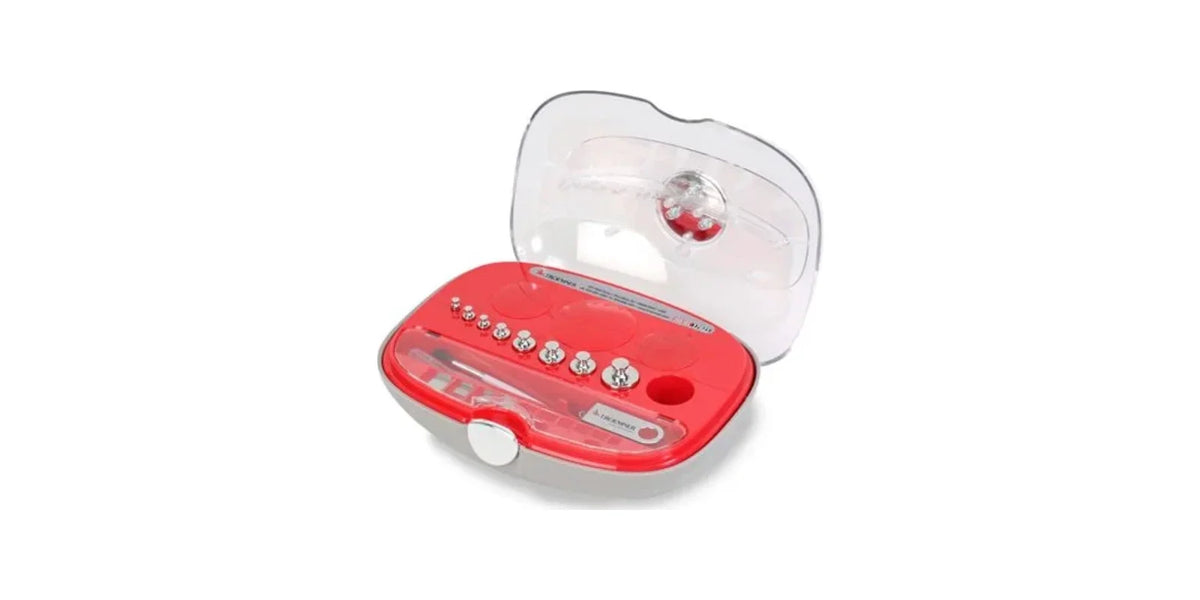
*Prices from libertyscales.com product pages on November 2, 2026. Prices can change; the product page always shows the current price. Each set comes in a protective case; 25 kg and 50 kg weights are not held in the case.

Filter by class and certificate in the calibration weights collection. If your quality system needs a certificate, choose the matching traceable or NVLAP listing.
Handling, storage and recalibration
A weight only stays in class if you look after it. Fingerprints, dust, scratches and corrosion all change its mass.
- Never touch weights with bare hands. Use tweezers for small weights and gloves or a lifting fork for larger ones.
- Store them in their case, closed, in a clean, dry room near the balance's temperature.
- Let weights acclimatize to the room before use, especially after moving them from a colder or warmer area.
- Clean gently as the manufacturer recommends; don't polish or scrub, which removes metal.
- Recalibrate on a schedule. Your quality system sets the interval, based on how often the weights are used and how much they drift. Any weight that is dropped or damaged should be recalibrated before it's used again.
Checking a balance with a test weight is a good routine habit, but adjusting or certifying scales, especially those used legal-for-trade, should be done by a qualified scale technician. Our bench scale calibration guide and scale accuracy guide cover the day-to-day checks.
Calibration weight class FAQs
What is the difference between ASTM and OIML weight classes?
Both set how far a weight may be from its nominal value. ASTM E617 numbers its classes (Class 1, Class 4 and so on) and is used mostly in the US. OIML R 111 uses letters (E1, E2, F1, F2, M1 and others) and is used internationally. Their tolerances differ, so they don't map one-to-one.
Which weight class do I need for an analytical balance?
For an analytical balance reading to 0.1 mg, ASTM Class 1 or OIML E2 is the usual starting point. If your SOP, auditor or a regulation such as USP <41> sets a requirement, follow that instead.
Is ASTM Class 1 the same as OIML E2?
No. They are used for similar balances, but the tolerances differ at each nominal value. If your procedure names one system, buy that class rather than an equivalent from the other system.
What is the difference between a traceable and an NVLAP certificate?
A traceable certificate documents the weight's calibration with traceability to NIST. An NVLAP certificate comes from a lab accredited to ISO/IEC 17025 under NVLAP, which many regulated and accredited labs require.
How often should calibration weights be recalibrated?
Your quality system sets the interval, based on how often the weights are used and how much they change between calibrations. Recalibrate any weight that has been dropped, damaged or handled without protection.
Can I calibrate my own scale with test weights?
You can check a balance or scale with test weights as a routine habit. Adjustment and certification, and anything used legal-for-trade, should be done by a qualified scale technician; check with your state weights and measures office for the rules where you are.
Find the right calibration weights
Browse the calibration weights collection, or read our guide to analytical vs precision balances. For help matching a class and certificate to your balance, call Liberty Scales at (661) 888-1919 or send us a message.