
How Much Does a Cow Weigh? Cow, Bull and Calf Weight Chart
Updated November 5, 2026
The short answer: a mature beef cow usually weighs about 1,000 to 1,600 lb, and 1,200 lb is the figure the industry has long used as "average," though many herds now run heavier. Dairy cows range from about 900 lb for a Jersey to about 1,500 lb for a Holstein. Mature bulls are commonly 1,700 to 2,300 lb, a beef calf is born at roughly 60 to 100 lb, and finished steers sold for slaughter recently averaged over 1,600 lb. The only way to know what your animals weigh is to put them on a scale, and below we explain why that matters and how to do it.
Cow weight chart: cows, bulls, calves and steers
| Animal | Typical weight | Source |
|---|---|---|
| Mature beef cow | About 1,000 to 1,600 lb; 1,200 lb is the long-used industry average | University of Missouri Extension; NDSU Extension |
| Holstein cow | About 1,500 lb | Florida Dairy Farmers |
| Ayrshire / Milking Shorthorn cow | About 1,200 / 1,250 lb | Florida Dairy Farmers |
| Guernsey cow | About 1,100 lb | Florida Dairy Farmers |
| Jersey cow | About 900 lb (800 to 1,200 lb range) | Oklahoma State University, Breeds of Livestock |
| Mature beef bull | About 1,700 to 2,300 lb | NDSU Extension |
| Beef calf at birth | About 60 to 100 lb (88 lb average in one NDSU herd) | NDSU Extension |
| Beef calf at weaning (about 6 to 7 months) | About 500 to 600 lb (558 lb average in the same herd) | NDSU Extension |
| Finished (fed) steer | 1,631 lb average; heifers 1,447 lb | USDA AMS 5-area report, week ending Oct 30, 2026 |
These are typical figures from the sources named, not limits. Breed, age, frame size, condition and feed all move the numbers, sometimes by hundreds of pounds.
How much does a beef cow weigh?
Producers, vets and nutritionists have long worked from 1,200 lb as the average beef cow. Real herds vary a lot around that number:
- In a University of Missouri Extension record-keeping project with about 500 cows from three herds, cows weighed anywhere from 662 to 1,730 lb, a spread of more than 1,000 lb.
- At NDSU's Dickinson Research Extension Center, a smaller-framed herd averaged about 1,295 lb at maturity and a medium-framed herd about 1,522 lb.
- Oklahoma State University Extension reports that mature cow weights rose quickly from the early 1990s to about 2004 and now appear to be leveling off.
Why it matters: a heavier cow eats more. Feed, mineral and pasture plans built on 1,200 lb will be wrong for a herd that really averages 1,450 lb. Weighing cows once or twice a year, at weaning or pregnancy checks, tells you what you are actually feeding.
How much does a dairy cow weigh?
Dairy breeds differ more than most people expect. Florida Dairy Farmers lists the Holstein at around 1,500 lb, the Milking Shorthorn near 1,250 lb, the Ayrshire about 1,200 lb and the Guernsey around 1,100 lb. The Jersey is the smallest of the major dairy breeds: Oklahoma State's Breeds of Livestock gives an average of about 900 lb, within an 800 to 1,200 lb range.
Dairy weights also swing through the lactation. A cow often loses condition after calving and regains it later, which is why many dairies track weight alongside body condition score instead of relying on one number.
How much does a bull weigh?
Bulls are the heaviest animals in most herds. NDSU Extension uses mature bull sizes of 1,700, 2,000 and 2,300 lb as typical levels, and notes that a yearling bull of about 1,300 lb can keep gaining roughly 300 lb a year until maturity. For a Jersey bull, Oklahoma State gives about 1,200 to 1,800 lb.
That weight matters for your equipment. A 2,200 lb bull is beyond the rating of many small livestock scales, so check the capacity before a bull ever steps on the platform. Never load a scale beyond its rated capacity.
Calf, weaned calf and fed steer weights
- Birth: in NDSU's Dickinson herd, calves averaged about 88 lb at birth over a five-year benchmark. Many beef calves fall between about 60 and 100 lb, and dairy breeds vary (Jersey calves are small, Holstein calves large).
- Weaning: the same herd averaged about 558 lb at weaning. Weaning weight is one of the best measures of a cow's productivity, which is why many producers adjust it to a standard 205 days to compare calves fairly.
- Finished cattle: in USDA's 5-area negotiated slaughter cattle report for the week ending October 30, 2026, live steers averaged 1,631 lb and live heifers 1,447 lb.
For calves specifically, our calf scale buyer's guide covers weighing from birth to weaning.
What changes a cow's weight
- Breed and frame size. Larger-framed cattle are heavier at maturity, as the NDSU herds show.
- Age. Cows keep growing for several years after their first calf, so first-calf heifers are usually the lightest females in a herd.
- Body condition. A thin cow and a fleshy cow of the same frame can differ by well over 100 lb.
- Stage of production. Late pregnancy adds the calf, fluids and placenta; early lactation often takes weight off.
- Gut fill. Feed and water in the rumen change live weight through the day. Weigh at a consistent time, ideally before feeding, when you compare weights.
How to weigh a cow (and why guessing costs money)
Experienced cattle people misjudge weight more often than they think, and a weight tape around the heart girth is only an estimate. Scale Blog compares five ways to weigh a cow by accuracy. A scale gives you numbers you can act on:
- Dosing: dewormers and other treatments are dosed by weight. Underdosing wastes product and can help parasites build resistance.
- Selling: when cattle sell by the pound, a few percent of error on a load is real money.
- Feeding and culling: weights tell you which cows wean heavy calves for their size and which do not.
The usual setups are:
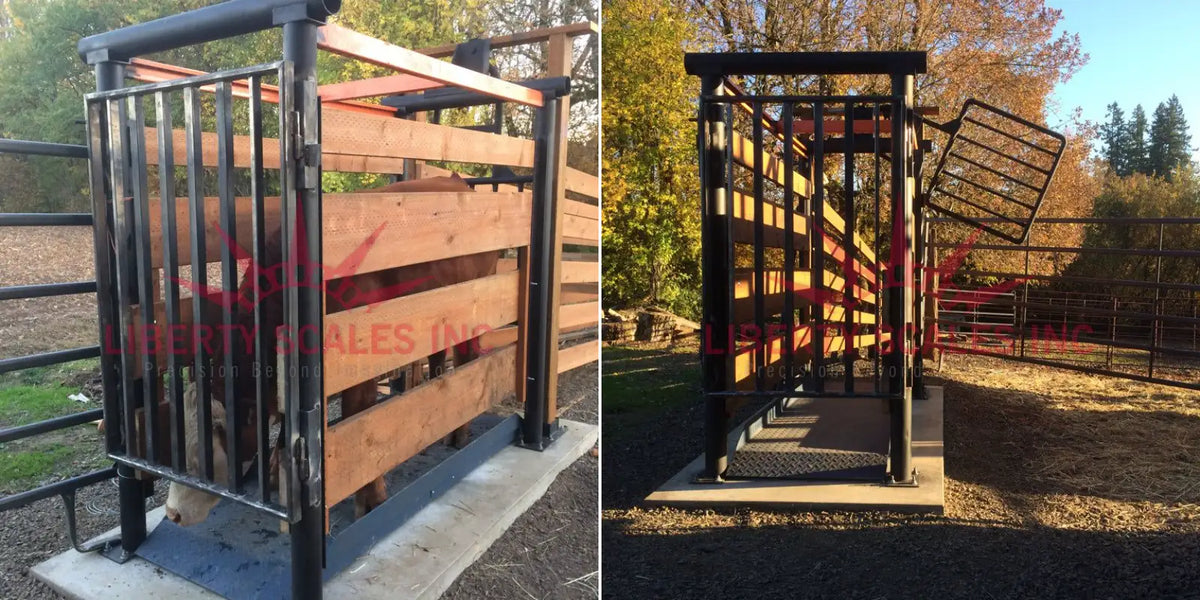
- Alleyway or chute scale: a long, narrow platform in the working alley, so cattle walk on one at a time. Best for regular weighing of grown cattle.
- Load bars (weigh beams) under a chute or platform: a pair of bars and an indicator turn an existing squeeze chute or a platform into a scale, and can move between sites.
- Cage scales: an enclosed platform for calves and smaller animals.
For a reading you can trust: set the scale on firm, level ground; zero it before the first animal and whenever manure builds up; make sure the animal is fully on the platform and nothing is touching the rails; and let it settle before you record the weight. If weights will be used to buy or sell cattle, your state may require a legal-for-trade scale that has been inspected and sealed, so check with your state weights and measures office and have a qualified scale technician handle installation and certification.
Cattle scales from Liberty, with prices
| Scale | Type | Sizes / capacity | Price* | Good for |
|---|---|---|---|---|
| LS-929 livestock scale for cattle | Alleyway scale | 7' x 26", 7' x 36" and 8' x 48" platforms | $1,378.99 to $3,448.99 | Weighing grown cattle one at a time in the alley |
| LS-919-HD weigh beam system | Load bars plus indicator | Several bar lengths, up to 20,000 lb | $665.99 to $1,608.99 | Turning a chute or platform into a scale |
| LS-WB weigh beam system | Load bars plus indicator | 24" to 60" bars, 5,000 to 20,000 lb by length | $573.99 to $1,148.99 | Budget weigh bars for chutes and crates |
| LS-930 5' x 7' cage system | Portable cage scale | 5' x 7' platform with cage | $2,873.99 | Calves, yearlings and smaller cattle |
*Prices from libertyscales.com product pages on November 2, 2026. Prices can change; the product page always shows the current price. Check each product's capacity against your heaviest animal before you buy.

Compare every option in our cattle scales buyer's guide, or browse the livestock and agriculture scales collection.
Cow weight FAQs
How much does a cow weigh on average?
A mature beef cow is commonly about 1,000 to 1,600 lb, and 1,200 lb is the long-used industry average. Dairy cows range from about 900 lb for a Jersey to about 1,500 lb for a Holstein.
How much does a cow weigh in tons?
About half a ton to three-quarters of a ton. A 1,200 lb beef cow is 0.6 US tons; a 1,500 lb Holstein is 0.75 tons.
How much does a bull weigh?
Mature beef bulls are commonly about 1,700 to 2,300 lb, according to NDSU Extension. Yearling bulls are often around 1,300 lb.
How much does a newborn calf weigh?
Most beef calves weigh roughly 60 to 100 lb at birth. In one NDSU herd, the five-year average was 88 lb.
What is the most accurate way to weigh a cow?
A livestock scale, such as an alleyway scale or load bars under a chute, is the most accurate. Weight tapes give an estimate only. Weigh at a consistent time of day so gut fill doesn't skew comparisons.
Do I need a certified scale to sell cattle by weight?
If the weight sets the sale price, your state may require a legal-for-trade scale that has been inspected or sealed. Check with your state weights and measures office, and have a qualified scale technician install and certify it.
Weigh your herd instead of guessing
See our cattle scales buyer's guide and calf scale guide, or browse livestock scales. For help choosing the right setup for your herd, call Liberty Scales at (661) 888-1919 or send us a message.