Stretch Wrapping Machines: The Quiet Upgrade That Pays for Itself at the Dock
Hand-wrapping pallets is one of those tasks that looks too small to matter until you add it up. A worker walking circles around a load, dragging a roll of film, doing it dozens of times a day. It is slow, it is physically punishing, and it quietly wastes money on every pallet through inconsistent wrapping and overused film. Most operations accept it as the cost of shipping. They should not. A stretch wrapping machine is one of the more straightforward returns on investment in a warehouse, and the payback is usually faster than buyers expect.
This guide covers where the savings actually come from, the main machine types, and how to choose one that fits how your dock really works.
Where the money actually comes from
Film savings
This is the big one, and it surprises people. A machine applies film with a consistent, controlled pre-stretch, which means it stretches each length of film far closer to its true capacity before it goes on the load. Hand-wrapping captures only a fraction of that stretch, so it burns through far more film per pallet for a weaker result. Over thousands of pallets, the difference in film cost alone often covers the machine. The cheapest film is the film you do not use, and a machine is how you stop wasting it.
Labor and throughput
A machine wraps a pallet in a fraction of the time a person takes, and it frees that worker for higher-value tasks instead of walking circles. On a busy dock, the throughput gain shows up immediately as pallets cleared faster and a line that stops backing up at the wrapping step.
Load stability and damage reduction
Hand-wrapping is inconsistent by nature, and an inconsistently wrapped load shifts, leans, and arrives damaged. A machine applies uniform containment force every time, producing stable loads that survive transport. Fewer damaged shipments means fewer claims, fewer returns, and fewer unhappy customers, which is a real cost that rarely makes it onto the spreadsheet but absolutely belongs there.
Worker safety
Manual wrapping involves repetitive bending, twisting, and reaching low to the ground, exactly the motions that drive strain injuries over time. Automating it removes a genuine ergonomic hazard, which protects your people and reduces the injury costs that come with the task.
The main types of stretch wrapping machines
Turntable wrappers
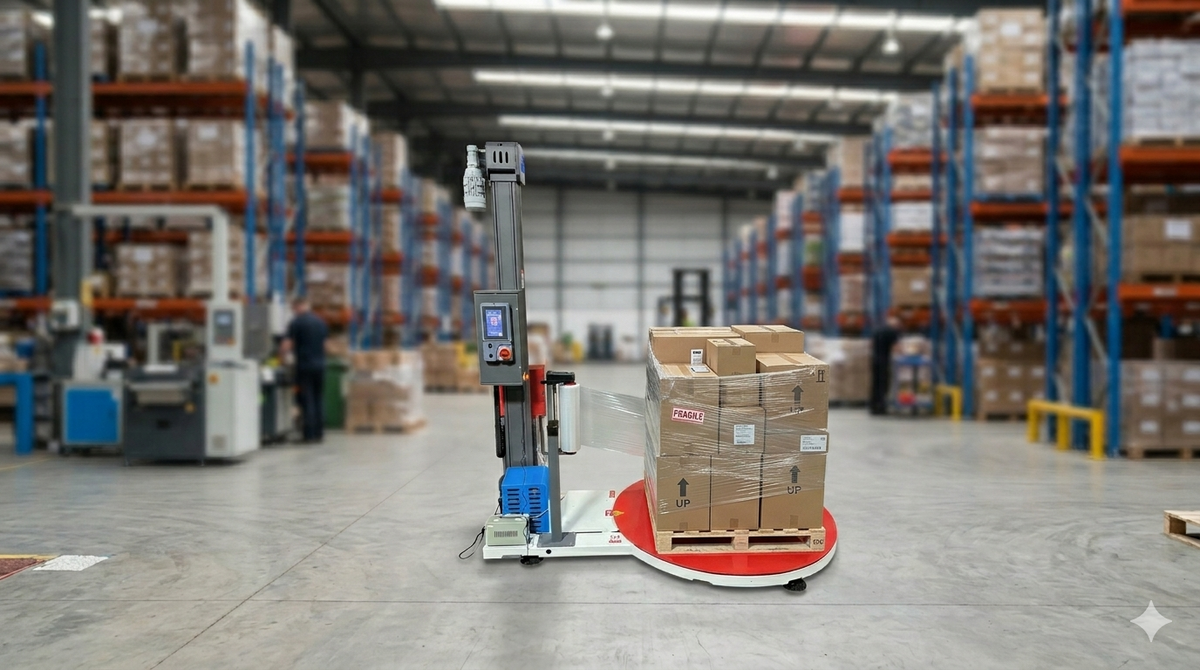
The most common type, a turntable machine rotates the pallet on a platform while a carriage applies film up and down the load. Reliable, cost-effective, and well suited to standard, stable pallets at low to moderate volumes, it is where most operations rightly start.
Rotary arm wrappers
Here the pallet stays still while an arm carrying the film orbits around it. Because the load never spins, rotary arm machines handle very light, unstable, or unusually heavy loads that a turntable would disturb, and they support higher throughput. They cost more and need more space, so they fit higher-volume operations.
Orbital and horizontal wrappers
For long products such as pipe, lumber, doors, and extrusions, horizontal orbital wrappers pass the product through a rotating ring of film, wrapping along the length rather than around a pallet. This is the answer for material that simply does not palletize in the usual way.
Semi-automatic versus automatic
Most operations buy semi-automatic first, and for good reason. A worker places the pallet, attaches the film tail, and starts the cycle, while the machine does the wrapping. It captures the large majority of the film, labor, and consistency benefits at a fraction of the cost of full automation. Fully automatic systems integrate with conveyor lines and wrap without an operator, which makes sense at high volume where the line never stops. Start with the level of automation your volume justifies, since a semi-automatic machine already delivers most of the return.
How to choose the right machine
-
Pallet volume per day, which separates semi-automatic from full automation
-
Load type and stability, where light or odd loads point toward a rotary arm
-
Load weight and dimensions, including any long products needing horizontal wrapping
-
Powered pre-stretch capability, since this is where the film savings live
-
Available floor space and whether the machine integrates with a conveyor
The single most important spec to confirm is powered pre-stretch, because that is the feature doing the heavy lifting on film cost. A machine without it leaves much of the savings on the table.
The bottom line
A stretch wrapping machine is rarely the most exciting purchase a warehouse makes, and it is often one of the smartest. The film savings alone frequently justify it, and the labor, throughput, load stability, and safety gains stack on top. Match the type and automation level to your volume and load profile, insist on powered pre-stretch, and the machine quietly pays for itself while making the dock faster and safer. The pallets still get wrapped either way. The only question is how much that wrapping costs you, and a machine is how you take control of the answer.
Explore stretch wrapping machines and packaging equipment at Liberty Scales, or contact our technical team to match a wrapper to your operation.